Posts

Showing posts with the label Sub-disciplines

A low ­carbon future through sector ­led change

In India, a sector-led, action-based approach could provide the framework to drive low-carbon transformation. In the build-up to the 'Leaders' climate summit organized by the united states this week (April 22-23), there has been a flurry of articles about whether India should announce a net-zero' emissions target, and by when. The Intergovernmental Panel on Climate change (IPCC) 1.5°C report called for global carbon emissions to reach net-zero by 2050, which the pressure cooker of climate diplomacy has quickly transformed diplomacy has quickly transformed into a call for all countries to announce 2050 as the net-zero target year. Yet, global net-zero may require some countries to reach net-zero before 2050 for others to have some additional time. Since a disproportionate share of the carbon space has been used up by developed countries, they must act boldly at home, to match the vigor of their diplomatic efforts. Nonetheless, as a climate-vulnerable country, India must also...


Geotechnical Engineering | Biological considerations in Geotechnical Engineering

Image
Geotechnical Engineering We all know that Geotechnical Engineering is a field of civil engineering which focuses on analyzing the geotechnical behaviors of soil and rocks. Usually, this type of engineering is involved in construction projects.  Engineers and Geotech engineering consultants will need to collect samples of the soil where a building or a structure is to be constructed. After having collected the soil samples, they will then analyze it in order to know if it is cohesive or not, and if the ground is stable or not. The ground needs to be stable in order for the structure to be built otherwise it might just collapse. However, these aren't just the things you need to know about Geotechnical Engineering . There are certain considerations that are involved. The understanding of the soil's behavior for the past 300 years has been centered on the mechanical principles and geological processes.  Later on, it involved mineralogy and the relevance of colloidal chemistry. A...

Forensic engineering

Image
According to a comprehensive definition, Forensic engineering is the investigation of products, structures, materials, or components that don't operate properly, leading to personal injuries or damages to property. The results of failure are handled by the law of product liability. A  Forensic engineer is usually called to carry out investigations in order to figure out the causes of equipment failures, fires, accidents, structural collapses, and safety system defects. There are cases when a building collapses for example. People get injured and the property is damaged. This is when structural engineers are called to inspect and approve the causes. There is a wide range of methods available for use in order to evaluate evidence and confirm particular details. Everything depends on the circumstances of the investigation and what is expected to achieve. The basic steps of any forensic investigation include collecting data, failure technical review, failure profile development, form...

Construction Engineering, What is Construction engineering and management, CEM

Image
Construction engineering generally involves whenever an airport, highway, dam, bridge, railway, or other large building projects goes up. Construction engineering is also seen in the design of the building and in the execution of the construction. While the design is an important part of the whole, While the design is an important part of the whole project, so they are choosing the right mix of materials and planning for all the different stages of construction. Students who undergo construction engineering courses must also do construction management courses so that they know what goes on at the construction site and could actually work as a construction manager . However, a construction manager could not work as a construction engineer as he has not had enough training in the design aspect. Rather, his training focuses more on the methods of construction and on people management. They are more concerned with delivering a quality project on time and at the required budget. So eng...

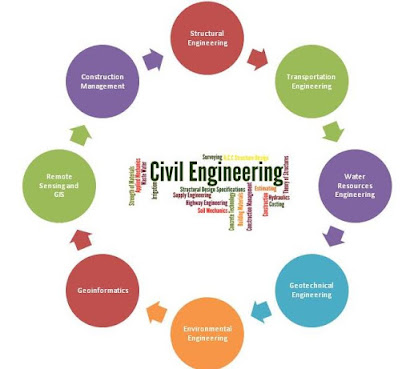
Sub-disciplines of Civil Engineering

Image
coastal engineering ,  Structural engineering ,  Construction engineering ,  Earthquake engineering,  Environmental engineering,  Forensic engineering ,  Geotechnical engineering,  Materials science and engineering,  Transportation engineering,  Municipal or urban engineering,  Water resources engineering,   Surveying.

Coastal engineering

Image
Coastal Engineering   deals with managing coastal areas. The challenge for coastal engineers to safely deliver clean water, power, and a sustainable natural and built environment for a world population. Millions of people and billions of dollars of infrastructure and communities are at risk of coastal flooding and loss of land due to sea-level rise, beach erosion, and loss of natural protection due to reefs.

Structural Engineering

Image
Structural engineering   Structural engineering is one of the many fields involved in civil engineering . They have the responsibility of designing buildings and machinery. Through continuous training in the very latest technologies, structural engineers are at the cutting edge of the design world. Engineering services clients range from the private to the public sector, and provide design and detailing of all types of structures. Structural Engineers: Structural engineers specialize in the design and analysis of any structure like a dam, bridges, buildings, towers, flyovers (overpasses), tunnels, microstructure, and other structures.  At any time there are adjustments or repairs completed to existing construction or framing for further space, an engineer will be part of the image. They are responsible for designing floors, roofs, columns, and beams. They are also responsible for determining how energy, heat, and moisture will interact within the building and its materials....